DENALI WEST BUTTRESS TRAVERSE
Overview
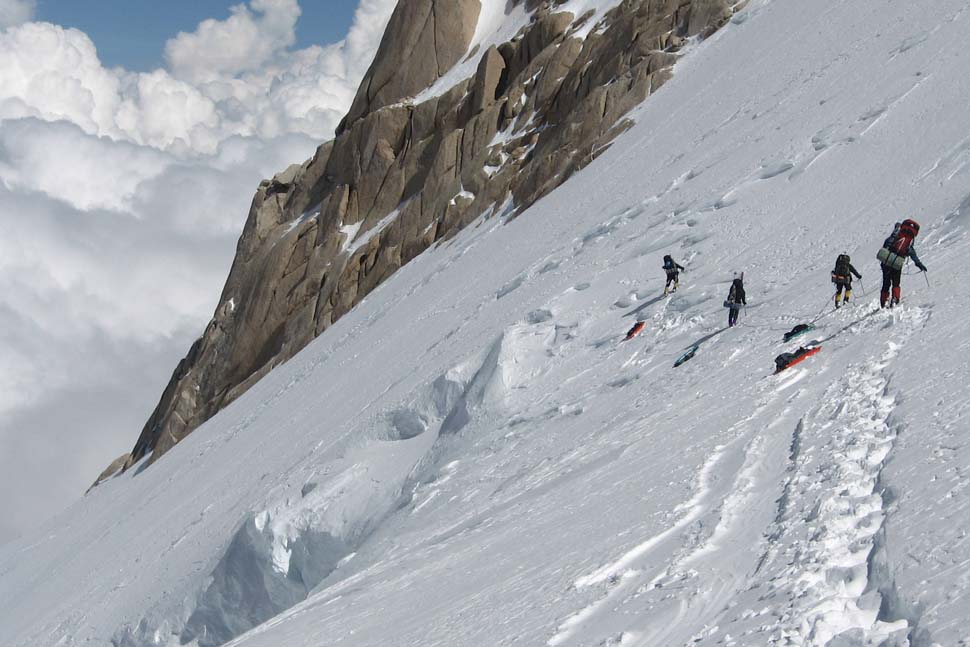
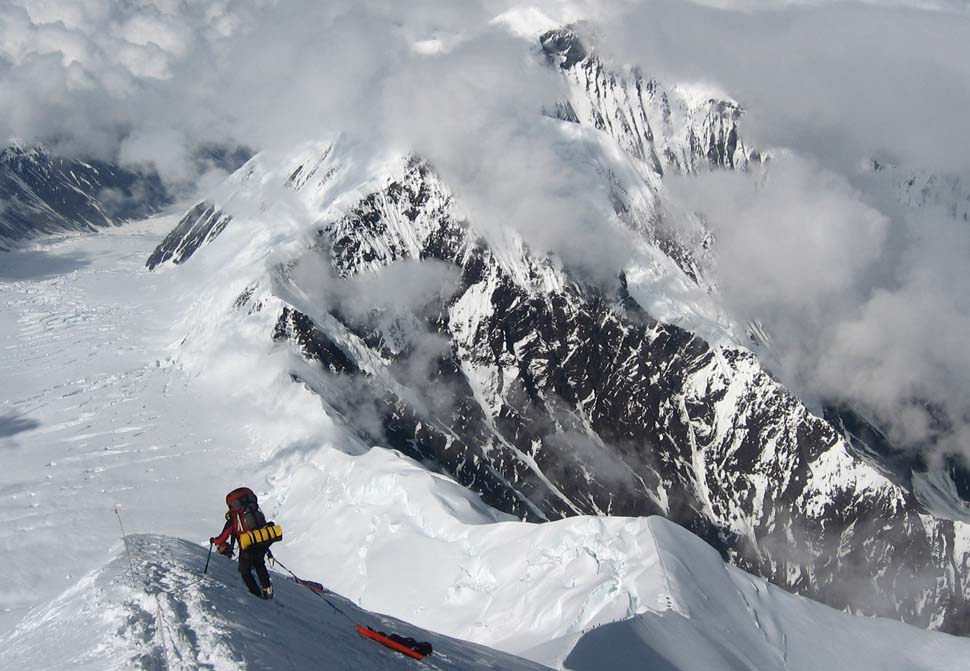
Our Denali Traverse climb ascends the West Buttress route to the summit of Denali and then descends the spectacular Karstens Ridge down to the Muldrow Glacier. This is a fantastic way for fit climbers to have an experience that less than 20 climbers a year receive. Descending onward through the Great and Lower Icefalls, climbers eventually gain McGonagall Pass and head out to the fabled Wonder Lake. You will descend over 18,000′ from the summit, one of the biggest vertical descents on the planet!
The walk out to Wonder Lake is about 25 miles of rolling terrain and can be done in one or two days. There is something special about climbing off the snowy mountain and in to the fragrant, green tundra and thick air! Your senses are re-awakened by the colors and the smells of life. There are several river crossings that may be difficult or, at the very least, exciting. Climbers who have done the traverse often comment that the descent was at least as memorable as, and often more challenging than, reaching the summit. This is a very physically challenging endeavor, which is significantly harder than climbing up and down the West Buttress, so an extra level of fitness is definitely required. The descent is often much more physically and mentally taxing than is the ascent, and it is not uncommon to experience 20+ hour days as you push through to safe areas to camp.
Training Climbs
The Traverse demands all of the winter camping skills of the West Buttress with an added dose of physical challenge and a much more complex glacier to negotiate on the way down. Climbers should place an emphasis on attaining a very high level of fitness before considering this route.
Aconcagua – This is a great entry into high altitude mountaineering and a good stepping stone before attempting Denali because the length of the trip is similar, but it is overall somewhat easier of an ascent, and therefore a good litmus test before spending three weeks on an arctic peak.
Denali West Buttress – A climb of the West Buttress might not be a bad idea for someone hoping to traverse the mountain. It probably seems like overkill, but we are including this to stress how serious the descent out to the north can be. More than one of our Traverse climbers has returned to do the route, after having climbed the West Buttress.
Vinson Massif – You could reasonably view this as a good training climb for Denali, as it is not as physically demanding and it is generally a shorter expedition. The new route to high camp is more challenging than the old route and this is a very expensive outing, so it might be better to see if you like big, cold mountains before flying to Antarctica.
Follow Up Climbs
The West Rib of Denali – The Rib is a step up in terms of technical difficulty, but shares some of the complex glacier travel and physical demands of the Traverse.
Mount Foraker, Sultana Ridge – After you’ve stood on the top and both sides of Denali, what to do next? Denali’s “little sister” presents a significant challenge for climbers who love climbing big, Alaskan peaks. The Sultana is technically a bit harder than the West Buttress, and demands the physical and mental toughness of the Traverse as it has a huge summit day and big exposure.
Cho Oyu – The sixth highest mountain in the world is a very accessible 8000 meter peak and a good choice for climbers who had a great experience on Denali. It is considered by many to be a prerequisite for stepping up to an Everest expedition, and can be reasonably thought of as an insurance policy to see how your body will do above 8000 meters.
Itinerary
Denali is a big, serious mountain with big mountain weather, geography and acclimatization issues. The following itinerary represents a very basic outline of what could happen on a given day during the course of a Denali expedition. Many factors can, and probably will, contribute to cause the following schedule to change. Our guides know the mountain and may elect to stray from this itinerary in order to give you the best possible shot at getting to the summit.
DAY 1: MEET IN ANCHORAGE. Team Meeting at 10 A.M. for an expedition orientation and equipment check. This is a very important meeting, which you must attend! Be sure to arrive in Anchorage early enough to make the meeting; which may require arriving a day early. We recommend staying at the Earth B&B, which is conveniently located. Reservations are available at: 907-279-9907
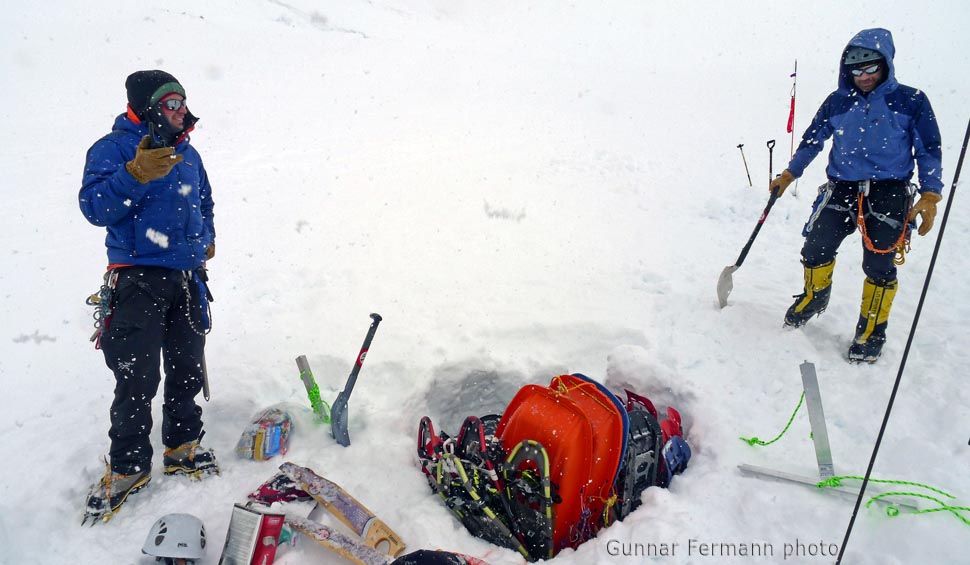
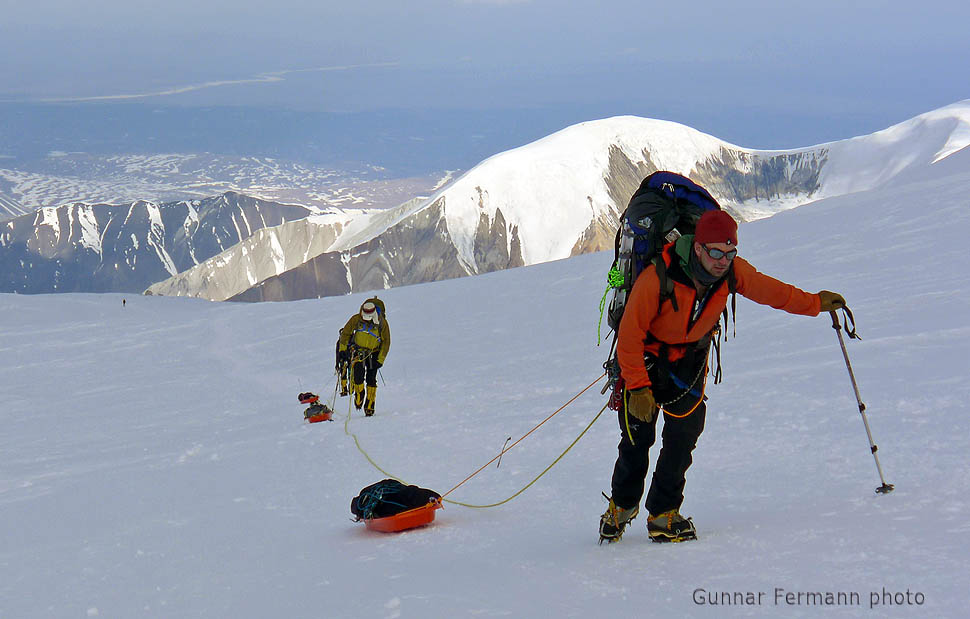
DAY 2: TRAVEL TO TALKEETNA AND FLY TO THE GLACIER. Team members will travel by shuttle the several hours to Talkeetna. Everyone will need to register with the National Park Service prior to flying to the glacier. Weather permitting; we will fly into the Kahiltna Glacier at 7,200 feet that afternoon. Once on the glacier, everyone will need to pitch in to get Base Camp established so we can proceed with our on-glacier expedition orientation that will cover the following topics: glacier travel, crevasse rescue, sled rigging, rope management and camp site procedures.
DAY 3: CARRY SUPPLIES TO CAMP 1. Departing base camp, we’ll drop down the infamous Heartbreak Hill and onto the broad Kahiltna glacier. Our goal will be to carry loads to the site of Camp 1 at 7,800feet, near the junction with the NE Fork of the Kahiltna Glacier. This is a moderate carry of about 9 miles round-trip and is a good shake-down for the upcoming days. Depending on the team and weather we may or may not return to Base Camp. Throughout the expedition we will follow the “climb high, sleep low” technique, for better acclimatization, however the altitude difference between Base Camp and Camp 1 is minimal enough to permit us to occasionally “single-carry” this stretch. On the late May and June expeditions, we may be doing our climbing early in the morning to avoid the excessive heat and soft snow conditions on the Lower Glacier.
DAY 4: MOVE REMAINING SUPPLIES AND ESTABLISH CAMP 1. (If the team double carries to Camp 1.)
DAY 5: HAUL LOADS UP TO KAHILTNA PASS. We’ll head out of Camp 1 and carry loads up Ski Hill. Several options exist for camp sites between 9,000 & 11,000 feet, depending upon weather, snow conditions and team strength. This is a moderately difficult carry of 7-9 miles round-trip, with 2- 3,000 feet of elevation gain and a return to Camp 1 for the night.
DAY 6: MOVE EVERYTHING TO CAMP 2. Camp is often in the 11,200’ basin at the base of Motorcycle Hill. This is an incredibly beautiful camp that basks in alpenglow when the sun travels around the north side of the mountain.
DAY 7: BACK-CARRY DAY. This is an “active rest day” during which we drop back down and pick up the cache we left down near Kahiltna Pass. It also helps give us another day to acclimatize before moving higher.
DAY 8: HAUL LOADS AROUND WINDY CORNER (13,300 FEET). Steep snow climbing up Itinerary p. 2 of 2 Motorcycle Hill rewards you with spectacular views. The total distance is about 4 miles round trip with a little over 2,000 feet of elevation gain. Fun climbing with crampons and ice axe gets you around Windy Corner where the upper Mountain comes into view-have your camera ready! ***Note that we have not planned on a “real” rest day before this point. 30+ years of guiding Denali has taught us that climbers fit enough to safely climb the upper mountain do not need rest days below Camp 3.
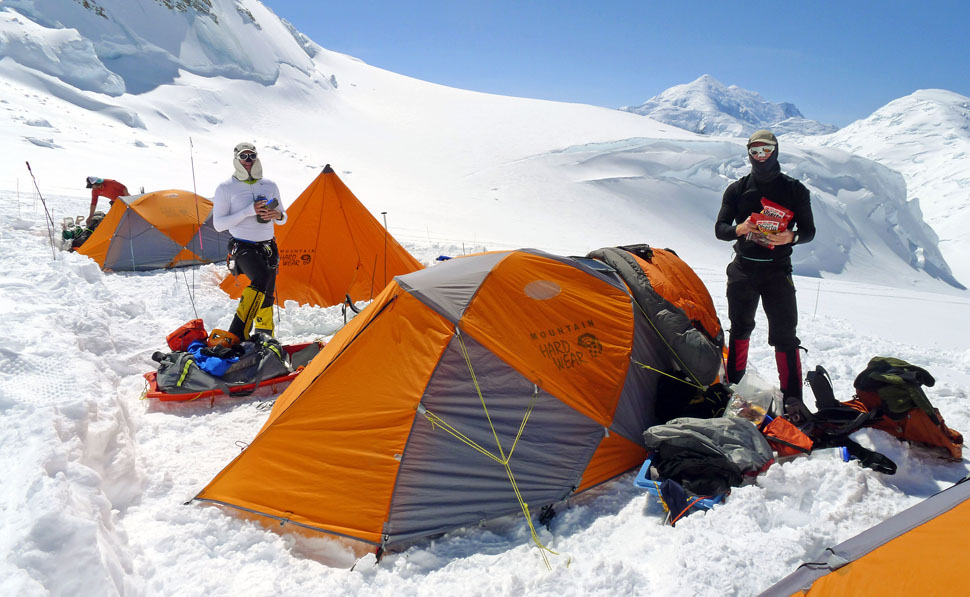
DAY 9: MOVE CAMP TO 14,200 FEET. This is usually a long, hard day. Camp 3 is located at the well equipped 14,200’ camp. Loads are getting lighter and the air is getting thinner. Hopefully everyone will have enough energy left to help get camp in as we need to fortify this camp due to the possibility for fairly severe weather.
DAY 10: BACK-CARRY DAY. This is another “active rest day,” during which the team will descend from Camp 3 to the Windy Corner cache and bring everything up to 14,200 feet. We’ll spend the afternoon going over climbing techniques that we will use in the upcoming days.
DAY 11: CLIMB UP THE HEADWALL TO THE RIDGE. Our goal is to cache supplies on the ridge and return to 14,200 feet. Climbing up the Headwall (fixed lines run from 15,500 to 16,100 feet) with a heavy pack is one of the more strenuous days of the trip, because of the steep terrain, heavy pack and thinning air. The views from the ridge can be as breath taking as the rarified air!
DAY 12: REST DAY. It is often prudent to take a rest/acclimatization day prior to moving up to High Camp.
DAY 13: MOVE TO HIGH CAMP ON THE BUTTRESS. Weather and team strength will again determine this decision. While there is a camp site at 16,100′, it is very exposed, so we usually push for the 17,200 ‘ site which is more secure and the better choice for camp. This is a really tough day, as our loads are big and the terrain is steep in sections. Rewards for our work are in the great climbing along the ridge. Weaving in and out of the rocks and occasionally walking a knife edged stretch, combine with big exposure to create one of the most memorable parts of the route.
From this point on, there are multiple strategies that we can employ to reach the summit and descend. The following is but one of these options…
DAY 14: REST DAY. Moving to 17,200’ and getting High Camp established can be a huge day, so we usually take a Rest Day before attempting the summit.
DAY 15: MOVE CAMP TO UPPER HARPER GLACIER CAMP. Another big day, as we carry our camp up and over the 18,000 foot Denali Pass and onto the Upper Harper Glacier from where we will make our summit bid. This camp enables us to have a shorter summit day and helps firm the team’s resolve for continuing with the Traverse.
DAY 16: SUMMIT DAY: If the weather is favorable, we’ll push for the summit. However if the weather is not good we will not go. It is important to be patient! We will only try for the summit when the weather is good, meaning mostly clear and calm. Our guides are the most experienced on the mountain and will make this sometimes difficult decision. The round trip climb will take eight to twelve hours or more. Usually you will depart camp early (7-9 a.m.), climb back up above Denali Pass (18,000’) and follow the West Buttress summit route past Arch Deacon’s Tower and the Football Field to the slopes leading to the Summit Ridge. On this spectacular ridge you can often see down into the Ruth Glacier with views of beautiful peaks such as Mooses Tooth, Mt Huntington and Mt Hunter.
***Summit Day is serious…
The weather needs to be good and everyone attempting the summit needs to have demonstrated that they can safely give it a shot. This is often the most grueling day of the expedition (some climbers say of their lives!). The guides have the ultimate decision as to when the team will make a summit bid. The guides also have the discretion to decide that a team member has not shown that he or she is capable to safely make a summit bid. Such occurrences are rare; but remember– your safety is our primary concern.
DAY 17: Descend through two icefalls on the Harper Glacier and down the steep and exposed Karstens Ridge. This is a huge day. Conditions and team fitness will dictate how far down the route we descend, but nonetheless, it is a very tough day.
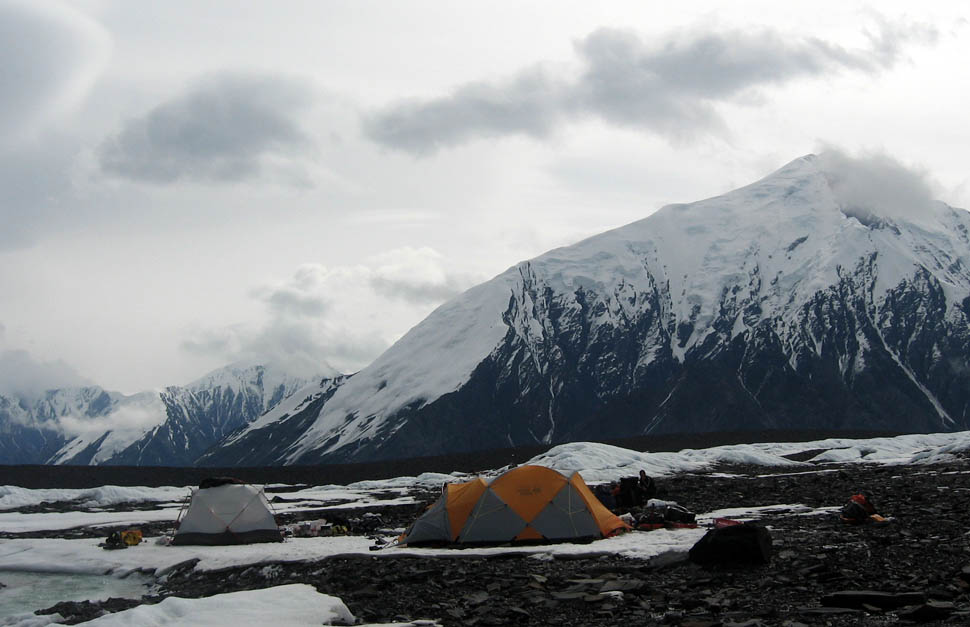
DAY 18: Descend the Muldrow Glacier and step off the ice and into the green surroundings of Cache Creek! This can be another huge day, depending on the condition of the Muldrow.
DAY 19: Hike out to the McKinley River. Sometimes we can cross the river and continue to Wonder Lake, but often we need to camp and wait for the flow of the river to abate somewhat overnight. Remember that the river flows from glaciers, which often freeze during the night and therefore their volume of flow decreases.
Day 20: Hike to Wonder Lake and catch the bus back to Denali Park. Joining a busload of tourists is often a highlight for our stinky climbers! We’ll pick up the team and transfer everyone back to Anchorage for showers, steaks and celebration!
Guide Tips
We cannot over-emphasize how much more challenging this expedition is than a climb up and down the West Buttress. You will descend through quite technical terrain, which often requires rappels or lowers through the steepest sections. Due to the complex nature of the terrain, there are only a handful of places where we can safely camp, and we need to make it to those locations, even if it means pushing onwards for 20+ hours, as has happened on our last two expeditions.
We cannot schedule this expedition any earlier in the season, as we must time it to descend after the National Park Service has the road to Wonder Lake opened for traffic. Therefore, our teams invariably descend the Muldrow Glacier in early to mid-June. The Muldrow in mid-June can be a maze of crevasses and can require some upper level route finding and a heightened sense of teamwork as climbers weave their way through such iconic sections as “The Hill of Cracks.”
The McKinley River can swell to impassable levels if the weather is rainy or exceptionally hot (glacier melt!). Occasionally, our teams have needed to wait for the river to drop before crossing. This is a first-class adventure, so prepare yourself mentally for come-what-may!
Equipment List
The following is a list of required gear for climbing the West Buttress with Mountain Trip. Many of the items on the list need to fit you well in order for you to fully enjoy your experience on the mountain. Please plan ahead with equipment purchased for your trip so you can be certain that your gear fits you well. The Kahiltna Glacier is not the place to discover that your pack is too small for your torso, or that your boots give you blisters. Recommended items reflect the opinions of our guides, but they may not necessarily fit you. They are also weighted toward a couple companies that are industry leaders in exhibiting environmental and social consciousness. We frequently update our equipment list to keep it current. Please click HERE for the latest version.
Call or email us with any gear questions. We want you to be as prepared as possible for your expedition.
Items with ** are optional, but recommended.
* FOOTWEAR
- MOUNTAINEERING DOUBLE BOOTS: Acceptable boots for Denali fall into two categories, traditional double boots and boot systems with integrated gaiters. Either variety works well, however the latter versions are lighter and arguably simpler. The goal is to have warm, comfortable feet! Try on a variety of boots as they all fit differently and get the one that fits well. Consider your future mountaineering objectives when purchasing boots as well.
- Recommended System Boots: LOWA “8000 GTX ”, LA SPORTIVA “OLYMPUS MONS EVO”
- Recommended Double Boots: SCARPA “INVERNO” with High Altitude Liners, LA SPORTIVA “NUPTSE” OR “SPANTIK”. A great upgrade to any plastic boot are the Denali Liners by Intuition. These are lighter and warmer than almost any stock liners. They are heat molded to fit your feet and are worth every penny. *** All double boots need Overboots and Gaiters, including the Spantiks
- OVERBOOTS: Neoprene overboots such as 40 Below Purple Haze are best. O.R. and Wild Country insulated Overboots work well if they fit with your crampons. Supergaiters alone are not warm enough for Denali.
- GAITERS: Full height, such as Black Diamond GTX Frontpoint Gaiter or Outdoor Research “Crocodiles.” Full coverage “Supergaiters” work great as well.
- BOOTIES**: Synthetic or down fill booties. These are great for camp and tent comfort and allow you extra opportunity to dry out your mountain boots.
GLACIER TRAVEL
- SNOWSHOES: Atlas Summit Series or the basic MSR Denali both work well, although a nice “upgrade” feature is a heel riser, which really helps make the steeper hills a bit more manageable. 22-25 inch snowshoes will generally work fine. ___
- SKI POLES: Select a proper length for hiking. Almost any ski pole will do, although adjustable poles work best! Black Diamond Flick Lock poles are recommended as they are less prone to spontaneously collapsing.
CLOTHING You will need a total of five (5) layers for your torso and four (4) for your legs:
- BASE LAYER: (1 or 2 sets) Synthetic Top and Bottoms such as Light or Mid-Weight Capilene from Patagonia. There are some really nice Merino wool options on the market as well. Patagonia has a nice entry called Wool 2.
- “EXPEDITION WEIGHT” FLEECE: Top and Bottoms made from 100 weight or Powerstretch fleece. A zip t-neck is important for ventilating. Guides’ Pick: Patagonia R1 Flash Top or the R1 Flash Hoody.
- STRETCH WOVEN PANTS: We used to consider this layer optional, but this “Soft Shell” layer is becoming indispensible, due to the broad comfort range it provides. Often pants made of Schoeller Dynamic or similar fabrics can be worn all the way to High Camp in lieu of less breathable “hard-shell” pants. Guides’ Pick: Patagonia Alpine Guide Pants
- FLEECE OR INSULATED PANTS: This layer must have side zippers! The best options for this layer are thick, “puffy” synthetic or down pants like the Patagonia Micro Puff Pants or Feathered Friends Volant Pants. These can be layered over your shell pants for easier and quicker layer changes.
- PRIMALOFT “PUFFY” JACKET: Size this to fit over your shell. We are fans of the puffy, Primaloft jackets because they are lighter and warmer than fleece and compress down much smaller. Guides’ Pick: Patagonia Micro Puff Hooded Jacket or the Outdoor Research Chaos Jacket
- SHELL JACKET & PANTS: They should be large enough to go over your pile clothing layers and the pants must have full lenght side zippers. These do not need to be the burliest Gore-Tex pieces you can find, but the Traverse does require Gore-tex or equivalent, as it can rain on the lower mountain to the north.
- EXPEDITION PARKA (WITH HOOD): Marmot, Mountain Hardwear and The North Face all make good parkas, but our Guides’ Pick is the Patagonia Down Parka. There are some synthetic options such as the Patagonia D.A.S. Parka and the Wild Things Belay Jacket, however; down is recommended as it is lighter and less bulky.
- VEST**: Fleece, puffy or down vest adds warmth to a light Expedition Parka. (OPTIONAL)
- T-SHIRT**: Synthetic long sleeve shirt for the lower glacier. Synthetics dry faster than cotton!
- REGULAR UNDERWEAR: One or two changes. Look for synthetics such as Patagonia Capilene.
- SOCKS: 2 – 4 sets of wool or synthetic medium/heavy weight socks. Make certain your socks fit with your boots!
- GLOVES: Light or medium weight bunting, polypro, Windstopper or even better: Schoeller fabric (one or two pairs.) Guides’ Pick: Outdoor Research Vert Gloves
- INSULATED GLOVES: Warm, insulated gloves are the workhorse on Denali. Black Diamond Guide Gloves have removable liners for ease of drying. It’s hard to stress how much you’ll be wearing these, so do not skimp on this item.
- SUMMIT MITTENS: Thick, warm, non-constricting mittens made of pile, Primaloft or down. Guides’ Pick: Outdoor Research Alti Mitts. They aren’t cheap, but are extremely warm. Divide the cost by 10 digits and they’re a bargain!
- WARM HAT: One warm hat or two hats of different weights. Wool or pile is fine. Your hat must provide ear protection.
- FACE MASK: Neoprene or Windstopper work equally well.
- SUN HAT: Baseball type or wide brimmed sun hat for the intense sunshine of the lower mountain. You can combine a baseball hat with a bandana for good sun protection
- HAND WARMERS: Bring 8+ sets of these disposable insurance policies.
- GLACIER GLASSES: They must have side protection and filter 100% UVA and UVB rays.
- SKI GOGGLES: For use while traveling during storms or during really cold spells.These must have double lenses and provide 100%UV protection.
PACKS
- EXPEDITION PACK: Unfortunately, it is getting harder to find a good expedition-sized back pack. Denali requires a 6000+ cu in. or 90+ liter pack to carry your gear, plus group food & equipment. The Dana Designs Terra Plane, Gregory Denali Pro and Osprey Aether 90 all fit the bill. BE CERTAIN THAT YOUR PACK FITS YOU! Get used to your pack; train with it!
- LARGE ZIPPERED DUFFEL: (36-48″) for use as a sled bag. Lightweight and inexpensive bags work fine, although if you can find the Patagonia Stellar Black Hole Bag you will be thrilled. It is lightweight and darn near water proof, making it the ideal sled bag!
SLEEPING GEAR
- EXPEDITION SLEEPING BAG: Rated to 30 below. Marmot Cwm, Col and Mt Hardwear Ghost are all great bags. Which to choose, down or synthetic? We prefer down bags because they are lighter, more compact, and have a longer lifespan than synthetics, but the new synthetics are getting a lot better. Guides’ Pick: Weighing in at just 4 pounds, the Valandre Odin is a -40 degree bag which is also suitable for Antarctica. It’s lighter companion, the Freja, is a -22 degree bag that only weighs 3 lbs 6 oz!
- COMPRESSION STUFF SACK: Granite Gear and Outdoor Research are both making nice, lightweight compression sacks. These are essential for sleeping bags and recommended for your summit clothes, such as your parka, mitts and warmest pants, so you might consider bringing two.
- 2 SLEEPING PADS: You need two pads, with one being a closed cell pad such as a Ridge Rest or a Karrimat just in case you poke a crampon through your air mattress. Therm-a-Rest inflatable pads have been among the warmest and most comfortable, but the new Exped pads from Outdoor Research are really nice. Guides’ Pick: Exped 7 paired with a Deluxe, Full-length Ridge Rest
TECHNICAL CLIMBING EQUIPMENT
- ICE AXE: (with leash) 70-80 cm length works well for the West Buttress and go 10-20 cm shorter for technical climbs. Guides’ Pick: Black Diamond Raven Pro
- CRAMPONS: 10 or 12 point crampons that FIT YOUR BOOTS! Step in or “New-matic” work equally well, just make sure they fit with your mountain boots and overboots. Fit is especially important with overboots! Black Diamond Guides’ Pick: Sabretooth Clip with ABS
- HARNESS: Your harness needs to have adjustable leg loops. Black Diamond Blizzard or Alpine Bod harnesses are both lightweight and functional.
- ASCENDERS: You need at least one full-sized ascender such as the Petzl Ascension. This can be paired with a second, handled ascender or with a lighter weight version such as a Petzl Tibloc, a Wild Country Ropeman or simply bring a prussik cord for your feet. If you opt for only one full sized ascender, consider bringing a left-handed one for ease of use on the fixed lines.
- CARABINERS: Bring two large locking carabiners and eight regular carabiners. Please do not bring “bent-gate” carabiners. These have certain limitations that do not make them appropriate for how we will use them. Mark them with colored tape for identification. Guides’ Pick: Black Diamond Neutrinos are very lightweight.
- PERLON CORD: 50 feet of 5 or 6 mm for sled and pack tie offs.
- CLIMBING HELMET: Unfortunately, even Alaska is not beyond the reach of Global Warming and there is now a stretch of the West Buttress route that necessitates the wearing of a climbing helmet. Get the lightest one you can find and make certain it fits over your warmest hat and under the hood of your shell. Guides’ Pick: Black Diamond Tracer
ESSENTIAL PERSONAL ITEMS
- NOSE GUARDS: Beko makes nice nose protectors that keep the wind and sun from wreaking havoc on your skin.
- STUFF BAGS (for your own items plus one large one for a cache bag)
- CAMELBACK HYDRATION SYSTEM (optional, but if you bring one, also bring an insulated tube and mouthpiece) This DOES NOT replace your Water Bottles!
- (2)ONE QT. WIDE MOUTH WATER BOTTLES: Please do not bring metal bottles or small mouth bottles.
- INSULATED COVER (1or 2 for your water bottles).
- LARGE PLASTIC CUP OR BOWL for eating (2-4 cup measuring bowl or Rubbermaid storage bowl work fine)
- INSULATED CUP 12 or 16 ounce plastic cup for hot drinks
- LARGE PLASTIC (LEXAN) SPOON
- 2 SMALL LIP BALMS (WITH 30+SPF): Two small tubes are easier to keep from freezing than one big tube.
- SUN SCREEN 3-4 OUNCES- two to four small tubes work better than one large tube
- TOILET PAPER: 1 or 2 rolls, depending on your technique
- TOILET KIT (Tooth brush & paste, floss, Handi-wipes, hand sanitizer… keep it small)
- P-BOTTLE Wide-mouth, collapsible Nalgene Cantenes work great- they make a 96 ounce version! Ladies- look for an appropriate adapter available at your local outdoors store. These items are both tough to find in Anchorage so plan ahead!
- PERSONAL MEDICAL KIT (Blister kit, aspirin, antacids, lozenges, Ibuprofen). PLEASE CONTACT YOUR PERSONAL PHYSICIAN FOR A LIST OF APPROPRIATE PRESCRIPTION MEDICATIONS. THERE ARE SOME VERY USEFUL PRESCRIPTION DRUGS THAT CAN SAVE YOUR LIFE AT ALTITUDE. CONTACT US FOR RECOMENDATIONS. OPTIONAL ITEMS
- CAMERA, with lots of film or digital and no film
- BOOK(s) for storm day reading
- JOURNAL & PENCIL
- ALTIMETER WATCH
- HAND LOTION
- FOOT POWDER
- MAPS
- BANDANAS
- NECK GAITOR (check out the light weight versions from Buff)
- SPARE SUN GLASSES
- LIGHTER
- SWISS ARMY KNIFE
- EXTRA ACCESSORY STRAPS** (generally only needed for smaller sized packs)
- PERSONAL MUSIC PLAYER (CD, MINI DISC, MP3 PLAYER, ETC with extra batteries)
- CELL PHONE (Due to antiquated cell phone infrastructure in this part of Alaska, only a small number of phones actually work from Denali. As of 2006, only phones capable of receiving ANALOG signals could function from the mountain.)
TRAVERSE CLIMB ONLY
- MOSQUITO REPELLENT
- HEAD NET
- TRAIL RUNNING or LIGHT HIKING SHOES (For river crossings and the walk out to Wonder Lake)
RENTAL ITEMS AVAILABLE
- SNOWSHOES ($50)
- SKI POLES ($15)
- CRAMPONS ($30)
- ICE AXE ($25)
- ASCENDER ($25)
- EXPEDITION PACK ($50-$100)
ALL EQUIPMENT ON THIS LIST IS AVAILABLE AT AMH IN ANCHORAGE -
And you get a 10% discount. Check out their Web site: www.alaskamountaineering.com or call 907 272-1811.
Feathered Friends in Seattle will also give you a 10% discount if you tell them you are joining one of our expeditions.
MAKE SURE YOU TRY EVERYTHING BEFORE YOU BRING IT ON DENALI!!
CALL OR EMAIL US WITH YOUR EQUIPMENT QUESTIONS.
Follow Us