Thoughtful words from Traian:
We all bring our loads to the mountains. And we rid ourselves of them not by dropping them at the base, but by carrying them to the top. A friend and I are in the process of doing just that with Mountain Trip, and we are expertly guided by Fermin, a calm and collected person who generously shares with us information about our trip, but also about Argentina in a broader sense.
Right now we are at Plaza Argentina, our Base Camp on the Ameghino Valley Route, where we enjoy great food and very hospitable staff. Tomorrow we move up to Camp 1, at 4,920 m. We just went through a medical checkup and were cleared to ascend, despite some ailments. I will talk about mine, as this was a first for me.
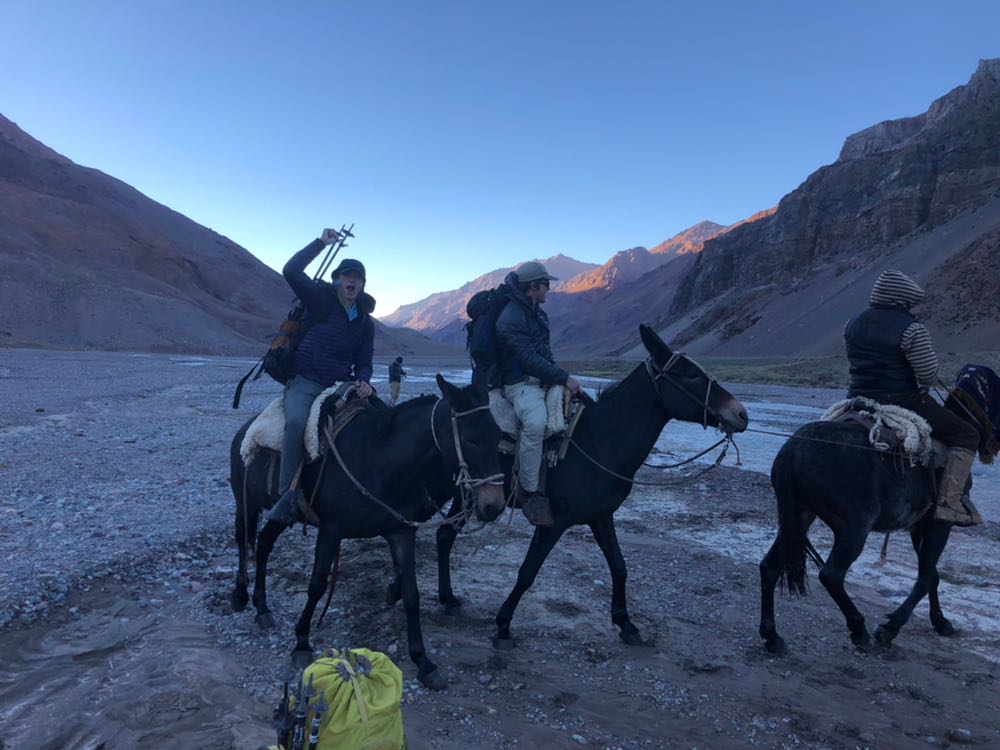
A MT team on the way to Plaza Argentina, crossing the river on mules!
On Day 1, hiking into the Vacas Valley, I was wearing my Julbo Monte Bianco, a loyal companion on several white and icy Alpine peaks. It turns out I foolishly thought they were Cat. 4 glasses. In fact, they are Cat. 3 glasses—an older model that does not state the category on the lens or temples. I even took them off a few times to wash my face in a stream. Big mistake, as I found out the next morning at Pampa de Leñas. I could barely see. I could see clearly up close, but past 1–2 m everything was blurred.
Fermin quickly got in touch with an ophthalmologist in Mendoza who suspected UV-induced mechanical keratitis. This was later confirmed at Base Camp. On a practical level, if I may give a piece of advice: buy new-generation glacier glasses that clearly state the category on the lens (Spectron 4, for example). What was good enough in the Alps, at 4,800+, was not sufficient at 2,200–2,700 m here.
Secondly, do not take them off—especially if you have big, beautiful, blue eyes, as I do. :))) These are not a plus up here, at this latitude. The sun is brutal; the light is intense.
Thirdly, if you do develop keratitis, I promise you it will stress you out a lot (it can be painful too), but do know that in the vast majority of cases it is fully reversible. So stay as calm as possible.
In any event, I went on, half-blind, to Casa de Piedra, where my eyesight became worse. I was still wearing those same Cat. 3 glasses, but on top of them I wore dark ski goggles too. On Day 3, we moved up to Base Camp, and Martín, an Argentine guide, sold me his Cat. 4 glasses, which I now wear nonstop when the sun is up. Things are improving, but my eyesight is nowhere near 20/20.
So, on a more philosophical note, I asked myself: if I cannot see properly the beauty around me, why do I go on? The honest answer is eye-opening (pun intended): I am NOT doing this purely for the beauty of the mountains. There is more. And that “more” is very personal.
I, for one, know for sure that I would go down in the blink of an eye (again, I know) if the price to pay for a peak were my physical integrity. That is where I draw the line. Anything below that line is my “more.”
Yesterday, coming back down to Base Camp from Camp 1 (4,920 m), where we had done a load carry, I realized that that would be the last time in my life that I would see that trail going down. I may live to be 100; this will still hold true.
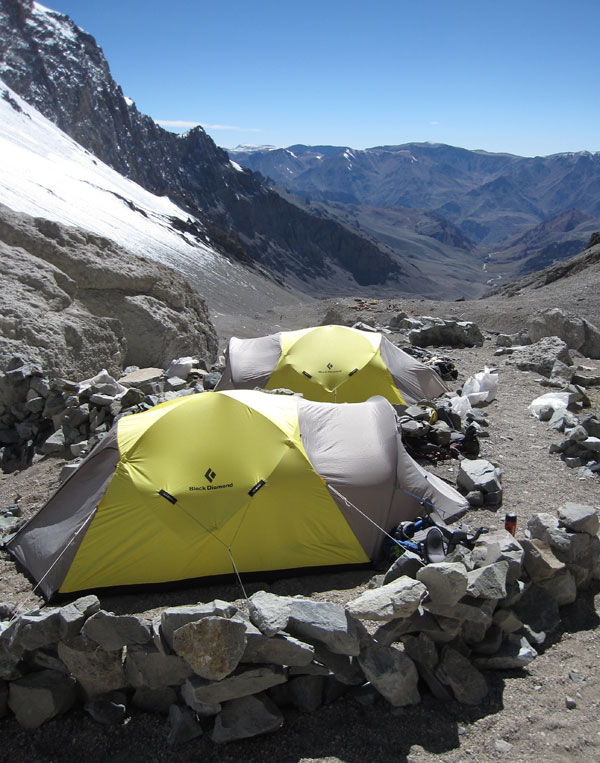
Camp 1, looking east
So, summing up, I am living a great experience. I am learning about my limits—my body, my mind—about what drives me to do what I do. Going to the mountains, in the end, is a deep dive within oneself. It is self-knowledge. And I believe there is no other type of knowledge that is more fundamental.
So come, do it. I promise that you will suffer, but you will define your “more.” And you will stop taking health for granted.
I will remember this trip as Ciego Aconcagua. Now let’s see that summit! Vamos!
