Thanks to everyone who was part of Mountain Trip Alaska’s 2025 Denali Season. All of our teams are off the mountain and back at home. We appreciate the support we received from our climbers, our guides, our partners in the National Park Service, Talkeetna Air Taxi, and the Lakefront Hotel in Anchorage. We also deeply appreciate each of the readers of our dispatch pages, who followed friends and family as they attempted to climb in what proved to be a very challenging year on Denali.
There were only a half-dozen or so summit days this season. That is very unusual, as most seasons see approximately 10-20 days that are appropriate for most mortals to summit. This season was also different in that we saw a season-ending wind and snow event that created an avalanche hazard that essentially prevented all summit opportunities from June 20 onward. Lead Mountain Trip Alaska guide Jordan Cargill, who led three teams on the mountain this season, wrote a description of what our last seven teams encountered:
“On June 25th through 26th, Denali endured a storm that involved light to moderate winds and significant, rapid snow accumulation at all elevations. The lower mountain and 14,000 feet and above received over a foot of new snow and Camp 2 at 11,000 feet received several feet. This rapid loading, the sheer volume of snow, and the late season solar intensity created a historic avalanche cycle above 14 Camp, with the Rescue Gully, Messner Couloir, and the Orient Express all running to the floor of Genet Basin.”
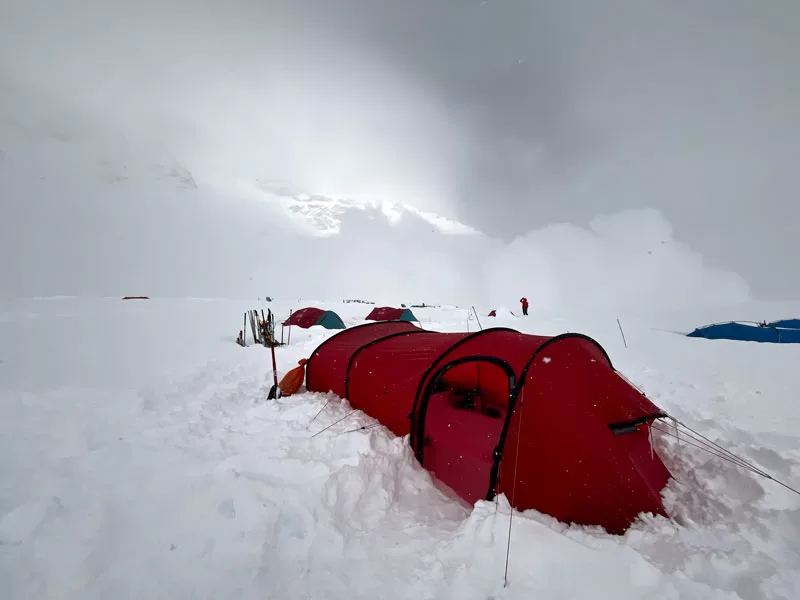
Avalanche cloud from the Messner Couloir hits Camp 3
It was the most significant avalanche cycle any of our guides had seen on the mountain, some of whom had more than 20 Denali expeditions under their belts.
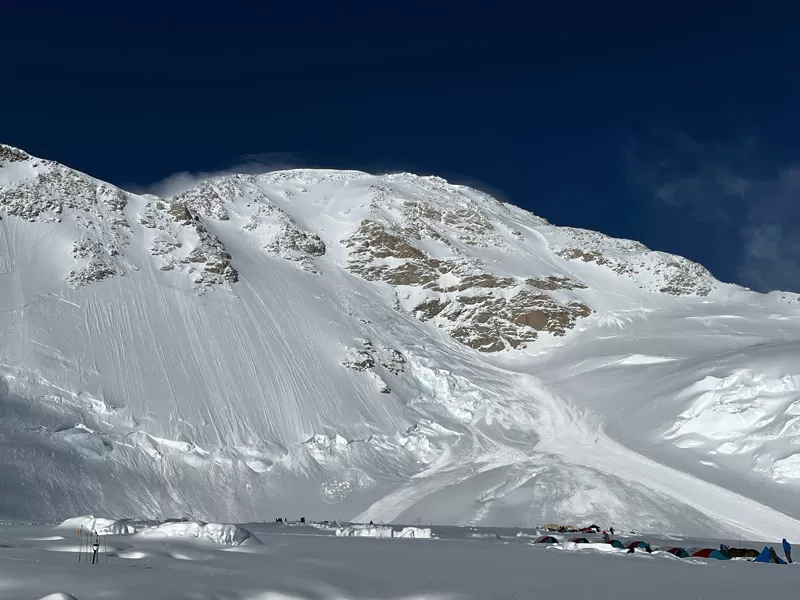
Avalanche cycle above Camp 3 on Denali, June 26, 2025
By June 28 weather and conditions allowed for the first teams to ascend to High Camp at 17,200 feet. It was immediately apparent that the route above camp, known as the Autobahn, which shares similar characteristics to the slopes that slid above 14 Camp, was loaded with fresh snow.
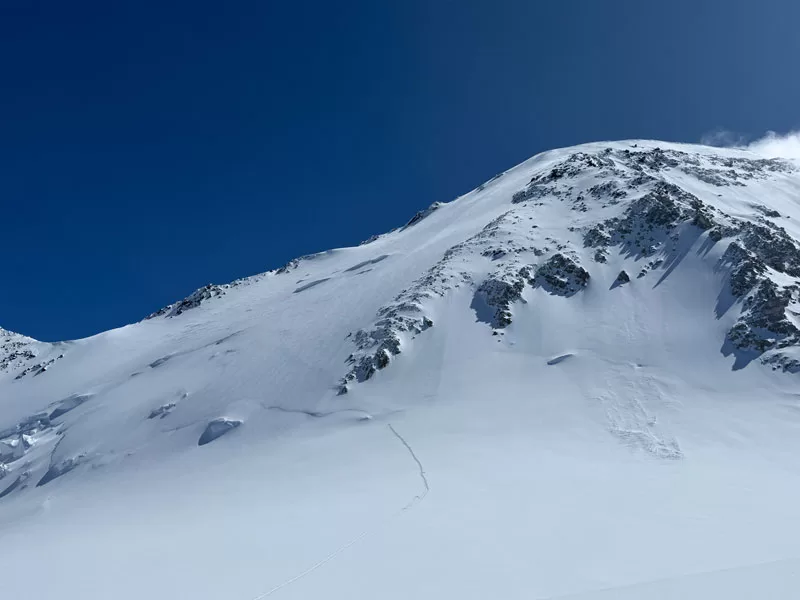
Arriving at High Camp, teams observed avalanche conditions on the Autobahn, June 28, 2025
Storms with deep snow totals high on Denali are rare, and rarer still are winds with the right speed and direction to load the Autobahn rather than strip it of snow. On the 29th Dallas Glass’s team started for their summit push, careful to make frequent investigations into the snowpack stability along their way. They quickly noticed several obvious signs of instability and the classic “strong over weak” snow setup that causes slab avalanche conditions. With clear red flags, the team descended back to High Camp and both Dallas and Marcus Bailado‘s teams (Mountain Trip Alaska’s June 9 and June 11 teams, respectively) ended their summit attempts.
Hopeful that time and settlement would help reduce the avalanche hazard, additional teams ascended to High Camp, and on the 30th a Mountain Trip Alaska guide team consisting of Aaron Diamond and Ashley Klassen went to the base of the Autobahn to investigate the snowpack and see if there were any changes in stability. After conducting several tests, they found that the instability had not changed, and worse, the weak layer consisted of a snow grain type known as facets, which can persist in the snowpack and create instability for weeks and even months.
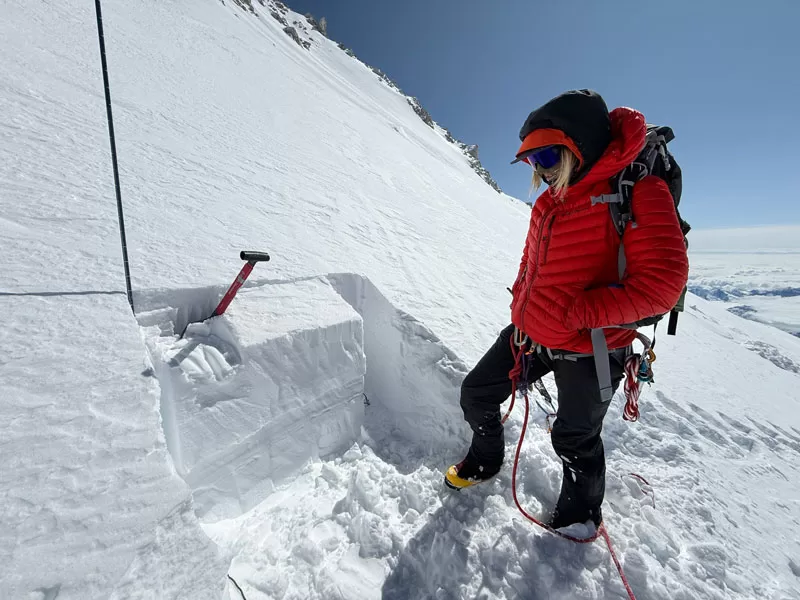
Mountain Trip Alaska guide conducts a snowpit test
The best bet for remedying the snowpack was a wind event that would strip the slab and the troublesome weak snow below, but, unfortunately, that would require winds from the opposite direction of the immediate forecast and longer-term weather trends. With the knowledge that we were dealing with a persistent avalanche problem and no remedy from mother nature in sight, the difficult decision was made for our teams to not climb any higher on the route this season. The likelihood that the problem would resolve along with a weather window suitable for an attempt within the remaining expedition time frames of the teams on the mountain was extremely low, and this ultimately resulted in the decision to descend.
We were fortunate to have a guide team on the mountain with an extremely high level of experience and training in assessing snow stability and managing avalanche problems. This was particularly important because this was the first time, in the collective memory of our time guiding on Denali, that such a problem has occurred this high on the mountain and made conditions too risky for a summit attempt.

We ran into similar conditions on our West Buttress attempt in 1987. Nick Parker, our Mountain Trip guide, came to the same conclusion and we reluctantly turned our backs on summit day and descended from the high camp at 17,200. Sometimes it’s better to respect Mother Nature and return another day.
Hey Bob, It’s good to hear some context from back in the 80’s, in the era of Nick Parker. It’s definitely best to listen to what the mountains are trying to tell you and not force it. Thanks for commenting!