DENALI VIA THE MULDROW GLACIER
Overview
Any climb of Denali is a tremendous undertaking; however in response to a growing number of requests, we also offer the added challenge of attempting the mountain from the North Side. We have run two North Side expeditions in the past couple of years and both were successful. Our early season Sourdough team was the first party to reach the summit of Denali in 2008.
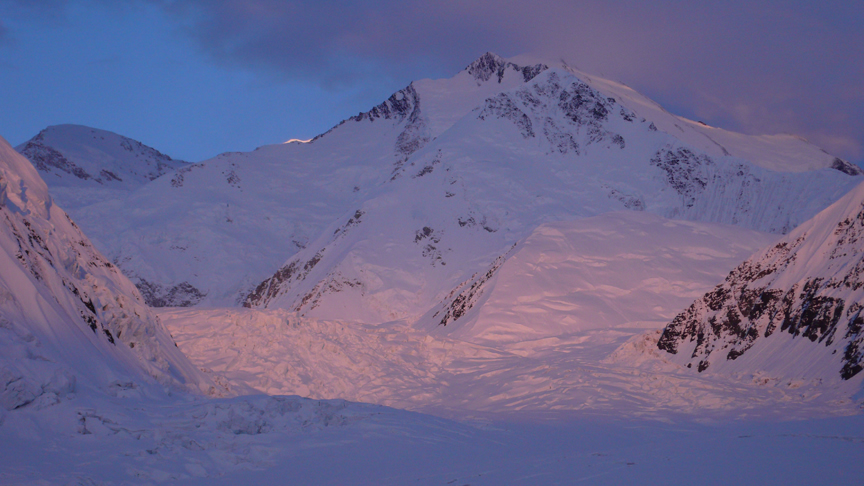
We will send two small teams in to climb Denali via the Muldrow Glacier Route. This is the same line of ascent taken by the Sourdough Expedition of 1910, although we will not follow their lead of dragging a 14 foot spruce pole up with us. The North Side of the mountain is a place reserved for the fit and the committed. This is a remote setting to undertake an arctic expedition and it lacks the “safety net” offered by the NPS and the number of climbers on the West Buttress. This is a longer, harder and more committing expedition than the West Buttress that is somewhat more technical as well. The rewards for your efforts will be beyond words as tremendous vistas unfold beyond your feet and you tangibly recognize that you are traveling where few have ever trodden.
We plan to send one team in by plane in early May and another team in by bus in early June. Please contact us for details and a complete itinerary. For the ultra-adventurous, we are also offering a climb of the North Side with a dog sled approach. You can read about our Sourdough Expedition HERE.
Itinerary
*** Thanks to MT guide Dave Ahrens for the detail in our itinerary!
DAY 1: We’ll check in with the Rangers in Talkeetna before driving to the Park headquarters and to catch the bus to Wonder Lake through the amazing Alaskan backcountry. This is a great opportunity to see the wildlife and get a sense of the scale of the Alaska Range. You typically will see caribou, grizzlies, arctic wolves, owls, beavers, moose and a wide variety of birds. The bus is often filled with photographers and frequent stops are taken for photo opportunities.
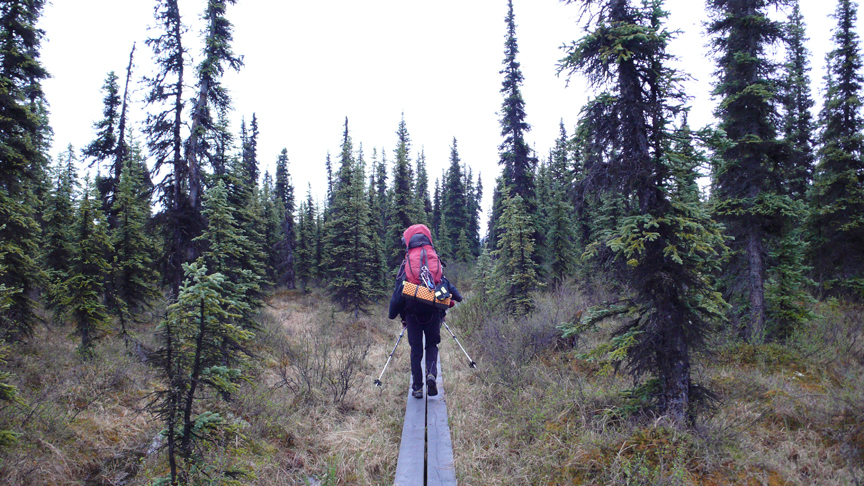
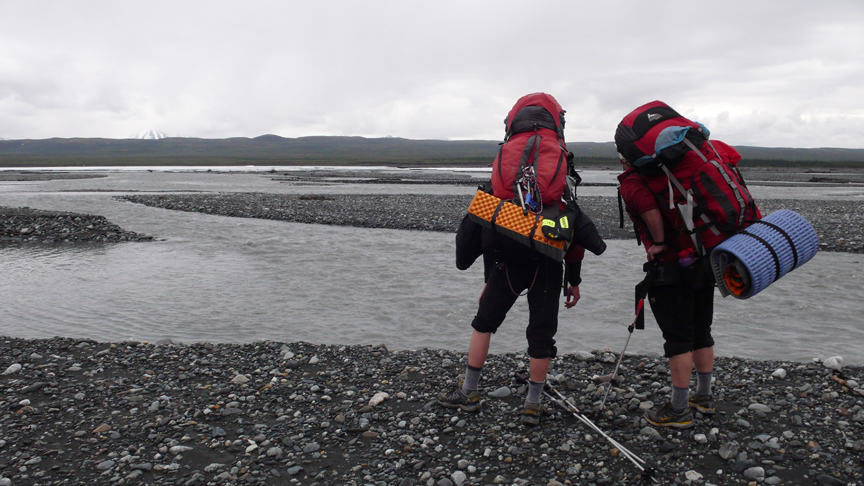
DAY 2: We’ll leave our camp at Wonder Lake and walk two miles downhill to the McKinley River Bar, a mile-wide, braided maze of silt filled, bitter cold water. After crossing several braids you can thaw your feet out before heading towards Turtle Hill on a horse-worn single track made by the first expedition that is often shared with caribou. After cresting Turtle Hill it’s all downhill and around the many lakes perched atop the ancient, now green, moraines of the Muldrow Glacier. Our camp at Cache Creek is often a nice riverside camp with crystal clear running water.
DAY : We’ll cross Cache Creek and head towards McGonagall Pass. (It was here that my last trip encountered a grizzly that mounted up on his back legs to better inspect us, while we made as much noise as possible. He sniffed and growled a bit before heading off in the opposite direction. I guess he wasn’t totally bored with us, as he then shadowed us for most of the day from across the valley. As we slowly transitioned to the alpine realm, we eventually left the grizzly to his lush tundra.) We climb into the narrowing high valley of McGonagall Pass and encounter a typically snow choked gully with a dog leg corner which leads you to your first view of the mighty Muldrow Glacier and Mount Brooks towering in the distance. It’s here that you may feel the brisk katabatic winds so commonly moving down from these large Alaskan glaciers. After exiting the Pass, we’ll work our way up the lateral moraine to the cache of supplies laid by our dog musher friends and our first night on the Muldrow.
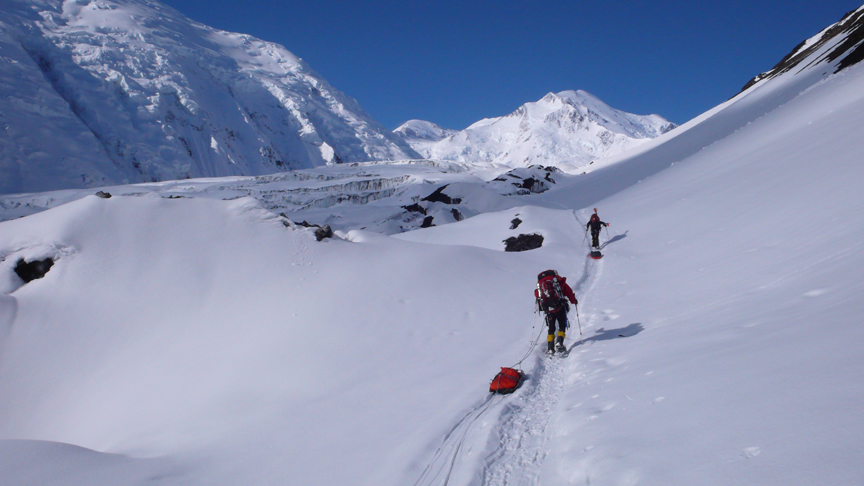
DAY 4: This is our first “cache day” or “carry day,” as well our initial interaction with our new friend, “sled.” After sorting through the cache over coffee we will head up the massive Muldrow glacier. The goal is to reach a nice camp spot below the Lower Icefall. We need to transport roughly half of our supplies to this spot and then dig a deep cache hole in the snow to guard against the ubiquitous ravens that are notorious for digging into and tearing apart less protected caches. It’s then a nice light hike back to camp. There are few crevasses to deal with on this day, as we are below the firn line and therefore some raw blue-ice glacier may be encountered.
DAY 5: Move day! We’ll follow yesterday’s trail, which we marked with bamboo wands and hopefully have a nicely beaten-in track to our camp at the base of the Lower Icefall.
DAY 6: This is an exciting day as we head into our first icefall and it provides a great introduction to glacier travel. There is often a less threatening passage along the right side of the glacier which follows a short broken route along the lateral moraine in order to avoid the more broken upper part of the ice fall. Once back on the glacier a weaving path avoiding cracks takes us to a flat area below the Hill of Cracks.
DAY 7: Move day…
DAY 8: Today we will establish a route to our last camp on the Muldrow. This day will test all the glacier travel skills you have honed over the past week. Our first challenge is to make our way through the, “Hill of Cracks”. This is a dynamic and ever-changing section of the Muldrow where the glacier flows over a large convex role, creating a maze of crisscrossing crevasses. Locating the path of least resistance that is completely dependent on snow conditions can make for an arduous passage through this tedious section.
Once through the Hill of Cracks, the Great Icefall towers above you. There is often a fairly direct route up via an obvious trough that weaves in and out of crevasses while huge seracs obscure much of your view. After a good amount of route finding, end running and some wide steps or jumps, we will arrive above the main mass of the icefall. Above this point we will travel up a gentle slope that works its way through some of the largest crevasses in the world and eventually leads to some compression zones below the Flat Iron, a large rock face coming of the prominent Pioneer Ridge. From this area, we will have our first view of the Harper Icefall which often is active. The large debris field stretching down glacier from its base is reason enough to stay away from this powerful formation. It is amongst these compression zones where we will establish our last camp on the Muldrow before heading up and onto Karstens Ridge.
DAY 9: Move camp through the slots and ice towers…
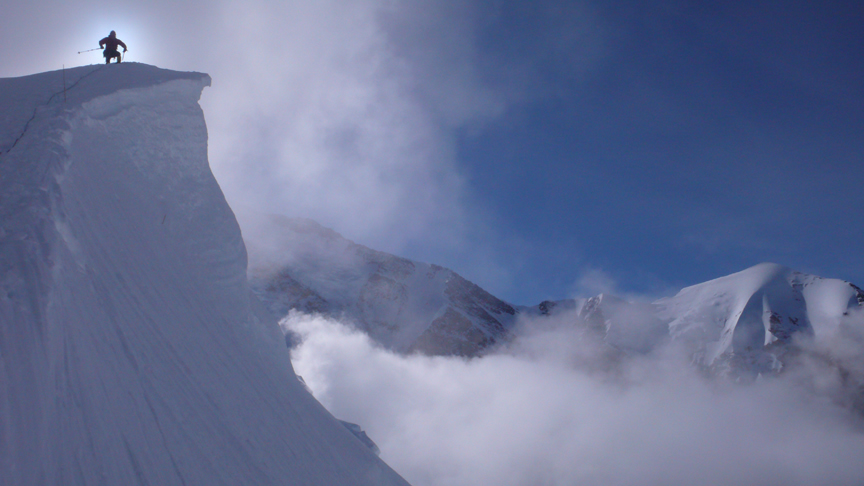
DAY 10: This day and the ones that follow offer some of the most amazing views of the expedition. Our first objective is to find a route onto Karsens Ridge. This can be a formidable challenge depending on glacier and avalanche conditions, and some steep snow climbing may be involved to reach the ridge proper. Once on the ridge you get your first glance of the Traleika Glacier some 2500ft below on the opposite side of the crest. We will work our way up the corniced ridge to a small camp. This ridge has changed more than any other part of this route in the past 10 years. There once was a shelf called the “Corral Camp” that offered ample camping, yet it has dwindled to a narrow exposed spot and no longer offers the once spatial and protected feel it once had. We will make a cache at the most protected compression offered that season and head back down to the Muldrow for one more night.
DAY 11: Move camp…
DAY 12: The amazing views continue as we work our way up the ridge with some running belays, leading to the bottom of the “Coxcomb,” a steep and avalanche prone section that leads to the top of Karstens Ridge. We often need to employ the use of fixed lines to get through this stretch. After reaching the top of Karstens Ridge we find ourselves at the 14,000ft Browne’s Tower camp overlooking the great Harper ice fall. This icefall is a stunning work of nature which at one point was nonexistent. Centuries ago, the Muldrow once continuously flowed all the way down from the 18,000′ Denali Pass. A glacial surge occurred, that separated the Muldrow from its upper reaches, which in turn became the Harper Glacier and separated the two by the aforementioned Harper Icefall. Here we will make a small cache and then head back down the Coxcomb with Mt Carpe and Mt Koven in the distance.
DAY 13: Move camp up and along the Coxcomb…
DAY 14: Today our goal will be to single carry onto the Harper glacier via a traverse across a steep and exposed slope. Once on the Harper we will continue to the climbers’ right side to avoid the large seracs of the first of two ice falls on the Harper. Once we make our way through the first ice fall we will establish camp below the second.
DAY 15: Move to High Camp! We will pass the second ice fall on right and head towards the 18,000′ Denali Pass separating the north and south summits of Denali. This is the camp from which we will make our summit attempt. It is a cold, exposed place and at 17,400ft putting in camp can be exhausting. With wind hammered firm snow it is often necessary to chisel platforms as opposed to digging them.
DAY 16: Rest and acclimatize before summit day.
DAY 17: Summit Day! Weather pending we will work our way towards Denali Pass where we will join the West Buttress route to the summit. While we have had numerous serious days before this point, this one is especially so. We need to have a good, clear day with low wind in order to mount a summit bid.
DAYS 18-19: Descend the West Buttress Route and fly out to Talkeetna!
***We have the possibility of descending the Muldrow Glacier route, which will add another 2-3 days to our descent.
Days 20-28: Contingency days
Training Climbs
Aconcagua – This is a great entry into high altitude mountaineering and a good stepping stone before attempting Denali because the length of the trip is long enough to give you a taste of expedition living, but it is a lot easier of an ascent of the Muldrow Glacier, and therefore a good litmus test before spending three to four weeks on the north side of an arctic peak.
Denali West Buttress – A climb of the West Buttress might not be a bad idea for someone hoping to ascend the Muldrow. It probably seems like overkill, but we are including this to stress how much more serious the north side can be. More than one of our Traverse climbers has returned to do the route, after having climbed the West Buttress.
Vinson Massif – You could reasonably view this as a good training climb for Denali, as it is not as physically demanding and it is generally a shorter expedition. The new route to high camp is more challenging than the old route and this is a very expensive outing, so it might be better to see if you like big, cold mountains before flying to Antarctica.
Follow Up Climbs
Cho Oyu might be a good choice, if you are interested in climbing an 8000m peak. After the Muldrow, there are no greater vertical elevation gains on the planet, so you might as well go higher!
Guide Tips
Reflections from the North Side – by Dave Ahrens
As a dedicated climber and career mountain guide I have been blessed to see some amazing parts if this planet we all call home. Yet none of them have captured me like the wild, dynamic and ever changing North Side of Denali. I first climbed the North side at age 19 with two friends from college, we cut our teeth on this route for a total of 36 days and learned a great deal about what it takes to embark on an expedition like this. Now, nine years and 13 Denali expeditions later, I feel fortunate to be able to introduce people to this powerful and remote place that has played a large role in my life and certainly has shaped me as a guide. As a climber, you often encounter a number of life situations in which you just don’t know how you will react until they present themselves. Denali’s North Side has certainly forced me to explore those areas whether it was dealing with a possible case of anaphylactic shock at High Camp, a collapsed tent in the middle of a three day storm or reminding me what it feels like to move for 20 long hours through terrible glacier conditions.
For anyone considering climbing this route I applaud you. Thinking of attempting this expedition means you seek a truly remote expedition and a heightened sense of adventure away from the perceived safety of the more traveled routes. I would recommend this route to anyone who seeks to appreciate a vast remoteness that most will never have the opportunity to truly experience on such a grand scale.
From green tundra, sprawling with animal life, to some of the largest icefalls and glaciers the range has to offer, this is truly a trip of a lifetime. Along with the remoteness of this route it also has a colorful history as the Muldrow was the primary route for early expeditions attempting the mountain long before the West Buttress was established by Bradford Washburn. I’d encourage you to read of these early expeditions and lots of other Denali history and geology in Bradford Washburn and David Robert’s book, Mount McKinley: The Conquest of Denali.
I honestly get goose bumps thinking about the humbling power and remoteness of this ever-changing route. While the route passes through some beautiful places, the physical and mental challenge of this undertaking should not be taken lightly. This route has forced me to work through my toughest days on Denali and it can be very intense. Objective hazards seem to lurk around every corner, from grizzlies to serac falls. The route is as much a mental challenge as it is a physical challenge and you should be prepared to adapt to situations as they arise. On all expeditions I like to point out that it is likely that everyone will have at least one bad day (maybe two or three!), but these days do pass and if you use them correctly they can teach you a great deal about yourself. So if you feel you’re up for a challenge, and are looking to learn about yourself, by all means, come on over to the North Side!
Equipment List
The following is a list of required gear for climbing the Muldrow Glacier route with Mountain Trip. Many of the items on the list need to fit you well in order for you to fully enjoy your experience on the mountain. Please plan ahead with equipment purchased for your trip so you can be certain that your gear fits you well. The Hill of Cracks is not the place to discover that your pack is too small for your torso, or that your boots give you blisters. Recommended items reflect the opinions of our guides, but they may not necessarily fit you. They are also weighted toward a couple companies that are industry leaders in exhibiting environmental and social consciousness.
Call or email us with any gear questions. We want you to be as prepared as possible for your expedition.
Items with ** are optional, but recommended.
* FOOTWEAR
- MOUNTAINEERING DOUBLE BOOTS: Acceptable boots for Denali fall into two categories, traditional double boots and boot systems with integrated gaiters. Either variety works well, however the latter versions are lighter and arguably simpler. The goal is to have warm, comfortable feet! Try on a variety of boots as they all fit differently and get the one that fits well. Consider your future mountaineering objectives when purchasing boots as well.
- Recommended System Boots: LOWA “8000 GTX ”, LA SPORTIVA “OLYMPUS MONS EVO”
- Recommended Double Boots: SCARPA “INVERNO” with High Altitude Liners, LA SPORTIVA “NUPTSE” OR “SPANTIK”. A great upgrade to any plastic boot are the Denali Liners by Intuition. These are lighter and warmer than almost any stock liners. They are heat molded to fit your feet and are worth every penny. *** All double boots need Overboots and Gaiters, including the Spantiks
- OVERBOOTS: Neoprene overboots such as 40 Below Purple Haze are best. O.R. and Wild Country insulated Overboots work well if they fit with your crampons. Supergaiters alone are not warm enough for Denali.
- GAITERS: Full height, such as Black Diamond GTX Frontpoint Gaiter or Outdoor Research “Crocodiles.” Full coverage “Supergaiters” work great as well.
- BOOTIES**: Synthetic or down fill booties. These are great for camp and tent comfort and allow you extra opportunity to dry out your mountain boots.
GLACIER TRAVEL
- SNOWSHOES: Atlas Summit Series or the basic MSR Denali both work well, although a nice “upgrade” feature is a heel riser, which really helps make the steeper hills a bit more manageable. 22-25 inch snowshoes will generally work fine. ___
- SKI POLES: Select a proper length for hiking. Almost any ski pole will do, although adjustable poles work best! Black Diamond Flick Lock poles are recommended as they are less prone to spontaneously collapsing.
CLOTHING You will need a total of five (5) layers for your torso and four (4) for your legs:
- BASE LAYER: (1 or 2 sets) Synthetic Top and Bottoms such as Light or Mid-Weight Capilene from Patagonia. There are some really nice Merino wool options on the market as well. Patagonia has a nice entry called Wool 2.
- “EXPEDITION WEIGHT” FLEECE: Top and Bottoms made from 100 weight or Powerstretch fleece. A zip t-neck is important for ventilating. Guides’ Pick: Patagonia R1 Flash Top or the R1 Flash Hoody.
- STRETCH WOVEN PANTS: We used to consider this layer optional, but this “Soft Shell” layer is becoming indispensible, due to the broad comfort range it provides. Often pants made of Schoeller Dynamic or similar fabrics can be worn all the way to High Camp in lieu of less breathable “hard-shell” pants. Guides’ Pick: Patagonia Alpine Guide Pants
- FLEECE OR INSULATED PANTS: This layer must have side zippers! The best options for this layer are thick, “puffy” synthetic or down pants like the Patagonia Micro Puff Pants or Feathered Friends Volant Pants. These can be layered over your shell pants for easier and quicker layer changes.
- PRIMALOFT “PUFFY” JACKET: Size this to fit over your shell. We are fans of the puffy, Primaloft jackets because they are lighter and warmer than fleece and compress down much smaller. Guides’ Pick: Patagonia Micro Puff Hooded Jacket or the Outdoor Research Chaos Jacket
- SHELL JACKET & PANTS: They should be large enough to go over your pile clothing layers and the pants must have full lenght side zippers. These do not need to be the burliest Gore-Tex pieces you can find! Many people are climbing Denali using lightweight, windproof, water resistant shells.
- EXPEDITION PARKA (WITH HOOD): Marmot, Mountain Hardwear and The North Face all make good parkas, but our Guides’ Pick is the Patagonia Down Parka. There are some synthetic options such as the Patagonia D.A.S. Parka and the Wild Things Belay Jacket, however; down is recommended as it is lighter and less bulky.
- VEST**: Fleece, puffy or down vest adds warmth to a light Expedition Parka. (OPTIONAL)
- T-SHIRT**: Synthetic long sleeve shirt for the lower glacier. Synthetics dry faster than cotton!
- REGULAR UNDERWEAR: One or two changes. Look for synthetics such as Patagonia Capilene.
- SOCKS: 2 – 4 sets of wool or synthetic medium/heavy weight socks. Make certain your socks fit with your boots!
- GLOVES: Light or medium weight bunting, polypro, Windstopper or even better: Schoeller fabric (one or two pairs.) Guides’ Pick: Outdoor Research Vert Gloves
- INSULATED GLOVES: Warm, insulated gloves are the workhorse on Denali. Black Diamond Guide Gloves have removable liners for ease of drying. It’s hard to stress how much you’ll be wearing these, so do not skimp on this item.
- SUMMIT MITTENS: Thick, warm, non-constricting mittens made of pile, Primaloft or down. Guides’ Pick: Outdoor Research Alti Mitts. They aren’t cheap, but are extremely warm. Divide the cost by 10 digits and they’re a bargain!
- WARM HAT: One warm hat or two hats of different weights. Wool or pile is fine. Your hat must provide ear protection.
- FACE MASK: Neoprene or Windstopper work equally well.
- SUN HAT: Baseball type or wide brimmed sun hat for the intense sunshine of the lower mountain. You can combine a baseball hat with a bandana for good sun protection
- HAND WARMERS: Bring 8+ sets of these disposable insurance policies.
- GLACIER GLASSES: They must have side protection and filter 100% UVA and UVB rays.
- SKI GOGGLES: For use while traveling during storms or during really cold spells.These must have double lenses and provide 100%UV protection.
PACKS
- EXPEDITION PACK: Unfortunately, it is getting harder to find a good expedition-sized back pack. Denali requires a 6000+ cu in. or 90+ liter pack to carry your gear, plus group food & equipment. The Dana Designs Terra Plane, Gregory Denali Pro and Osprey Aether 90 all fit the bill. BE CERTAIN THAT YOUR PACK FITS YOU! Get used to your pack; train with it!
- LARGE ZIPPERED DUFFEL: (36-48″) for use as a sled bag. Lightweight and inexpensive bags work fine, although if you can find the Patagonia Stellar Black Hole Bag you will be thrilled. It is lightweight and darn near water proof, making it the ideal sled bag!
SLEEPING GEAR
- EXPEDITION SLEEPING BAG: Rated to 30 below. Marmot Cwm, Col and Mt Hardwear Ghost are all great bags. Which to choose, down or synthetic? We prefer down bags because they are lighter, more compact, and have a longer lifespan than synthetics, but the new synthetics are getting a lot better. Guides’ Pick: Weighing in at just 4 pounds, the Valandre Odin is a -40 degree bag which is also suitable for Antarctica. It’s lighter companion, the Freja, is a -22 degree bag that only weighs 3 lbs 6 oz!
- COMPRESSION STUFF SACK: Granite Gear and Outdoor Research are both making nice, lightweight compression sacks. These are essential for sleeping bags and recommended for your summit clothes, such as your parka, mitts and warmest pants, so you might consider bringing two.
- 2 SLEEPING PADS: You need two pads, with one being a closed cell pad such as a Ridge Rest or a Karrimat just in case you poke a crampon through your air mattress. Therm-a-Rest inflatable pads have been among the warmest and most comfortable, but the new Exped pads from Outdoor Research are really nice. Guides’ Pick: Exped 7 paired with a Deluxe, Full-length Ridge Rest
TECHNICAL CLIMBING EQUIPMENT
- ICE AXE: (with leash) 70-80 cm length works well for the West Buttress and go 10-20 cm shorter for technical climbs. Guides’ Pick: Black Diamond Raven Pro
- CRAMPONS: 10 or 12 point crampons that FIT YOUR BOOTS! Step in or “New-matic” work equally well, just make sure they fit with your mountain boots and overboots. Fit is especially important with overboots! Black Diamond Guides’ Pick: Sabretooth Clip with ABS
- HARNESS: Your harness needs to have adjustable leg loops. Black Diamond Blizzard or Alpine Bod harnesses are both lightweight and functional.
- ASCENDERS: You need at least one full-sized ascender such as the Petzl Ascension. This can be paired with a second, handled ascender or with a lighter weight version such as a Petzl Tibloc, a Wild Country Ropeman or simply bring a prussik cord for your feet. If you opt for only one full sized ascender, consider bringing a left-handed one for ease of use on the fixed lines.
- CARABINERS: Bring two large locking carabiners and eight regular carabiners. Please do not bring “bent-gate” carabiners. These have certain limitations that do not make them appropriate for how we will use them. Mark them with colored tape for identification. Guides’ Pick: Black Diamond Neutrinos are very lightweight.
- PERLON CORD: 50 feet of 5 or 6 mm for sled and pack tie offs.
- CLIMBING HELMET: Unfortunately, even Alaska is not beyond the reach of Global Warming and there is now a stretch of the West Buttress route that necessitates the wearing of a climbing helmet. Get the lightest one you can find and make certain it fits over your warmest hat and under the hood of your shell. Guides’ Pick: Black Diamond Tracer
ESSENTIAL PERSONAL ITEMS
- NOSE GUARDS: Beko makes nice nose protectors that keep the wind and sun from wreaking havoc on your skin.
- STUFF BAGS (for your own items plus one large one for a cache bag)
- CAMELBACK HYDRATION SYSTEM (optional, but if you bring one, also bring an insulated tube and mouthpiece) This DOES NOT replace your Water Bottles!
- (2)ONE QT. WIDE MOUTH WATER BOTTLES: Please do not bring metal bottles or small mouth bottles.
- INSULATED COVER (1or 2 for your water bottles).
- LARGE PLASTIC CUP OR BOWL for eating (2-4 cup measuring bowl or Rubbermaid storage bowl work fine)
- INSULATED CUP 12 or 16 ounce plastic cup for hot drinks
- LARGE PLASTIC (LEXAN) SPOON
- 2 SMALL LIP BALMS (WITH 30+SPF): Two small tubes are easier to keep from freezing than one big tube.
- SUN SCREEN 3-4 OUNCES- two to four small tubes work better than one large tube
- TOILET PAPER: 1 or 2 rolls, depending on your technique
- TOILET KIT (Tooth brush & paste, floss, Handi-wipes,… keep it small)
- P-BOTTLE Wide-mouth, collapsible Nalgene Cantenes work great- they make a 96 ounce version! Ladies- look for an appropriate adapter available at your local outdoors store. These items are both tough to find in Anchorage so plan ahead!
- PERSONAL MEDICAL KIT (Blister kit, aspirin, antacids, lozenges, Ibuprofen). PLEASE CONTACT YOUR PERSONAL PHYSICIAN FOR A LIST OF APPROPRIATE PRESCRIPTION MEDICATIONS. THERE ARE SOME VERY USEFUL PRESCRIPTION DRUGS THAT CAN SAVE YOUR LIFE AT ALTITUDE. CONTACT US FOR RECOMENDATIONS. OPTIONAL ITEMS
- CAMERA, with lots of film or digital and no film
- BOOK(s) for storm day reading
- JOURNAL & PENCIL
- ALTIMETER WATCH
- HAND LOTION
- FOOT POWDER
- MAPS
- BANDANAS
- NECK GAITOR (check out the light weight versions from Buff)
- SPARE SUN GLASSES
- LIGHTER
- SWISS ARMY KNIFE
- EXTRA ACCESSORY STRAPS** (generally only needed for smaller sized packs)
- PERSONAL MUSIC PLAYER (CD, MINI DISC, MP3 PLAYER, ETC with extra batteries)
- CELL PHONE (Due to antiquated cell phone infrastructure in this part of Alaska, only a small number of phones actually work from Denali. As of 2006, only phones capable of receiving ANALOG signals could function from the mountain.)
TRAVERSE CLIMB ONLY
- MOSQUITO REPELLENT
- HEAD NET
- TRAIL RUNNING or LIGHT HIKING SHOES (For river crossings and the walk out to Wonder Lake)
RENTAL ITEMS AVAILABLE
- SNOWSHOES ($50)
- SKI POLES ($15)
- CRAMPONS ($30)
- ICE AXE ($25)
- ASCENDER ($25)
- EXPEDITION PACK ($50-$100)
ALL EQUIPMENT ON THIS LIST IS AVAILABLE AT AMH IN ANCHORAGE -
And you get a 10% discount. Check out their Web site: www.alaskamountaineering.com or call 907 272-1811.
Feathered Friends in Seattle will also give you a 10% discount if you tell them you are joining one of our expeditions.
MAKE SURE YOU TRY EVERYTHING BEFORE YOU BRING IT ON DENALI!!
CALL OR EMAIL US WITH YOUR EQUIPMENT QUESTIONS.
Follow Us